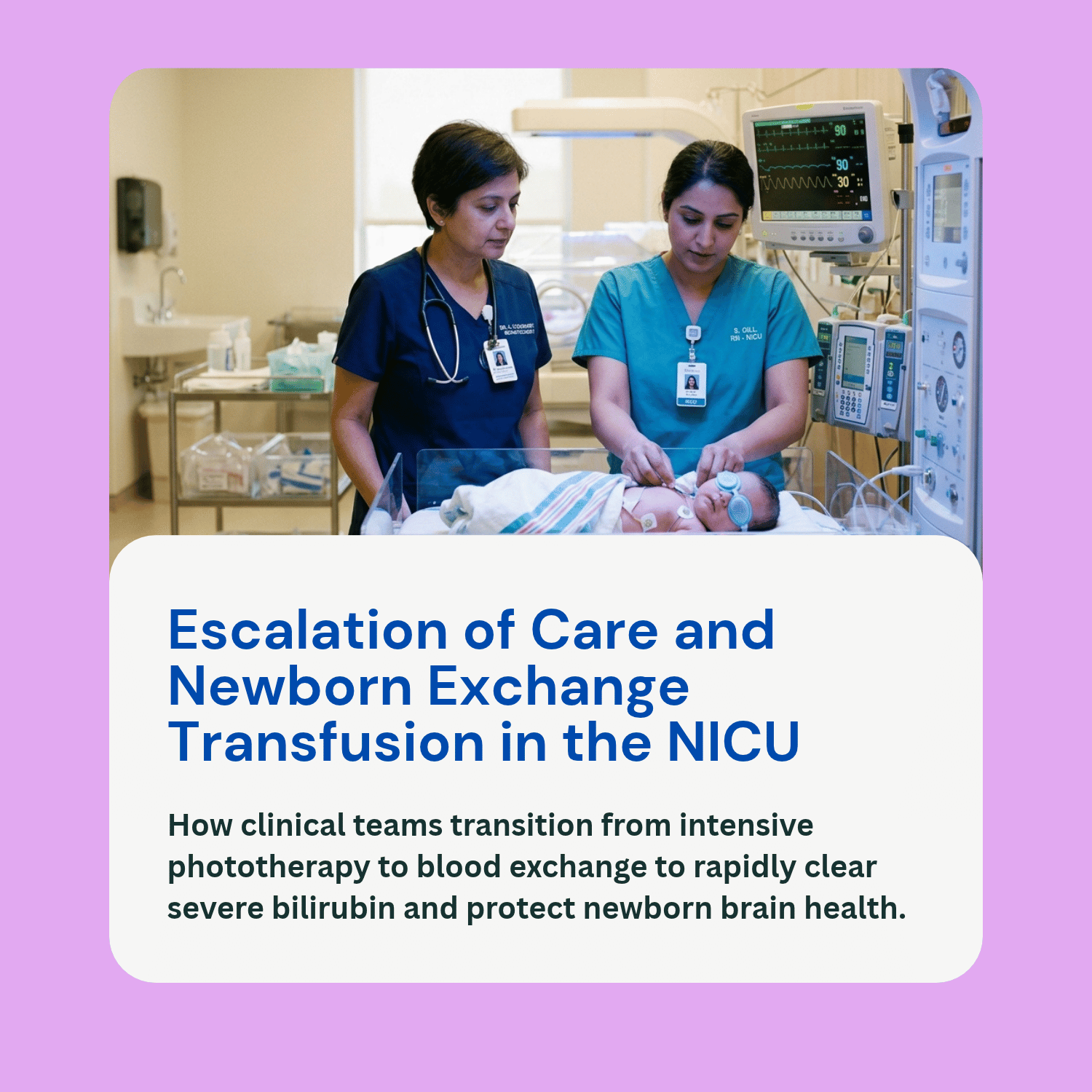

When Is Exchange Transfusion Used for Severe Newborn Jaundice?
Mild jaundice is common during the first week of life as a newborn’s liver adjusts to processing bilirubin, a yellow pigment produced when red blood cells break down. In the vast majority of infants, frequent feeding or standard light therapy safely clears excess bilirubin. However, when bilirubin levels rise rapidly or reach dangerously high concentrations, standard measures may not act fast enough to protect the developing brain from neurotoxicity. In these urgent clinical situations, neonatologists initiate a newborn exchange transfusion to rapidly remove bilirubin from the bloodstream.
Understanding when and why doctors recommend a newborn exchange transfusion helps families navigate a stressful Neonatal Intensive Care Unit (NICU) admission. Unlike general overviews of common newborn jaundice, this educational guide focuses specifically on the medical escalation of care for severe hyperbilirubinemia. Guided by American Academy of Pediatrics (AAP) clinical practice guidelines, this article explains why care teams escalate treatment, how exchange transfusion differs from intensive phototherapy, what occurs during the procedure, and how teams monitor recovery afterward.
Why Care Teams Escalate Treatment Beyond Phototherapy
Unconjugated bilirubin can cross the newborn blood-brain barrier if blood levels become severely elevated. Excessive bilirubin accumulation in brain tissue causes acute bilirubin encephalopathy (ABE), which can progress to permanent neurological injury known as kernicterus, affecting motor control, muscle tone, and hearing pathways.
To prevent neurotoxicity, the AAP clinical practice guideline establishes a structured protocol known as escalation of care when an infant’s total serum bilirubin approaches or exceeds established exchange thresholds, or when early neurological symptoms appear:
Rapidly Rising Bilirubin from Hemolysis: Conditions that destroy red blood cells rapidly—such as Rh incompatibility, ABO blood group incompatibility, or Glucose-6-Phosphate Dehydrogenase (G6PD) deficiency—can flood the bloodstream with bilirubin faster than standard therapies can clear it.
Insufficient Response to Intensive Phototherapy: If bilirubin levels continue rising despite maximal light exposure and intravenous hydration, care teams recognize that non-invasive clearance is insufficient to outpace ongoing bilirubin production.
Neurotoxicity Risk Factors: Prematurity (gestational age under 38 weeks), sepsis, severe acidosis, or low serum albumin levels lower the level at which bilirubin can enter brain tissue, prompting earlier escalation.
Early Signs of Acute Bilirubin Encephalopathy: Regardless of the exact laboratory number, any clinical signs of bilirubin neurotoxicity—such as high-pitched crying, extreme lethargy, poor feeding, arching of the back or neck (retrocollis or opisthotonus), or abnormal muscle tone—require immediate emergency intervention.
How Exchange Transfusion Differs from Phototherapy
Parents often wonder why doctors transition from overhead blue lights to an invasive blood procedure. While both therapies aim to prevent bilirubin neurotoxicity, they operate through completely different biological mechanisms and timelines:
Intensive Phototherapy (Light Conversion): Phototherapy uses specific blue-green light wavelengths to alter the shape of bilirubin molecules in the skin through photoisomerization. This structural change turns bilirubin into water-soluble isomers that the baby’s liver and kidneys can excrete in urine and stool without requiring conjugation. While highly effective for moderate-to-high jaundice, phototherapy relies on the infant’s own circulation and elimination organs, meaning bilirubin levels drop gradually over several hours.
Newborn Exchange Transfusion (Physical Removal): Exchange transfusion is a direct, mechanical clearance procedure. Small, measured aliquots of the infant’s blood are carefully withdrawn and replaced with equal volumes of cross-matched, screened donor red blood cells suspended in plasma. A double-volume exchange replaces roughly 85 percent of the infant’s circulating blood volume. This process immediately removes circulating bilirubin, clears maternal antibodies responsible for red blood cell destruction, and corrects severe anemia simultaneously.
What Families Can Expect During Escalation and the Procedure
When an infant enters the AAP escalation of care pathway, the medical team acts immediately while preparing for a potential exchange transfusion. Because preparing cross-matched donor blood takes time, clinicians maximize supportive treatments during the waiting period:
Immediate Pre-Exchange Stabilization: The baby is admitted to a specialized NICU, placed under continuous overhead and underneath intensive LED phototherapy lights, and given intravenous fluids to maintain hydration. If red blood cell breakdown is driven by Rh or ABO antibodies, doctors may administer intravenous immunoglobulin (IVIG) to help block antibody-mediated red blood cell destruction.
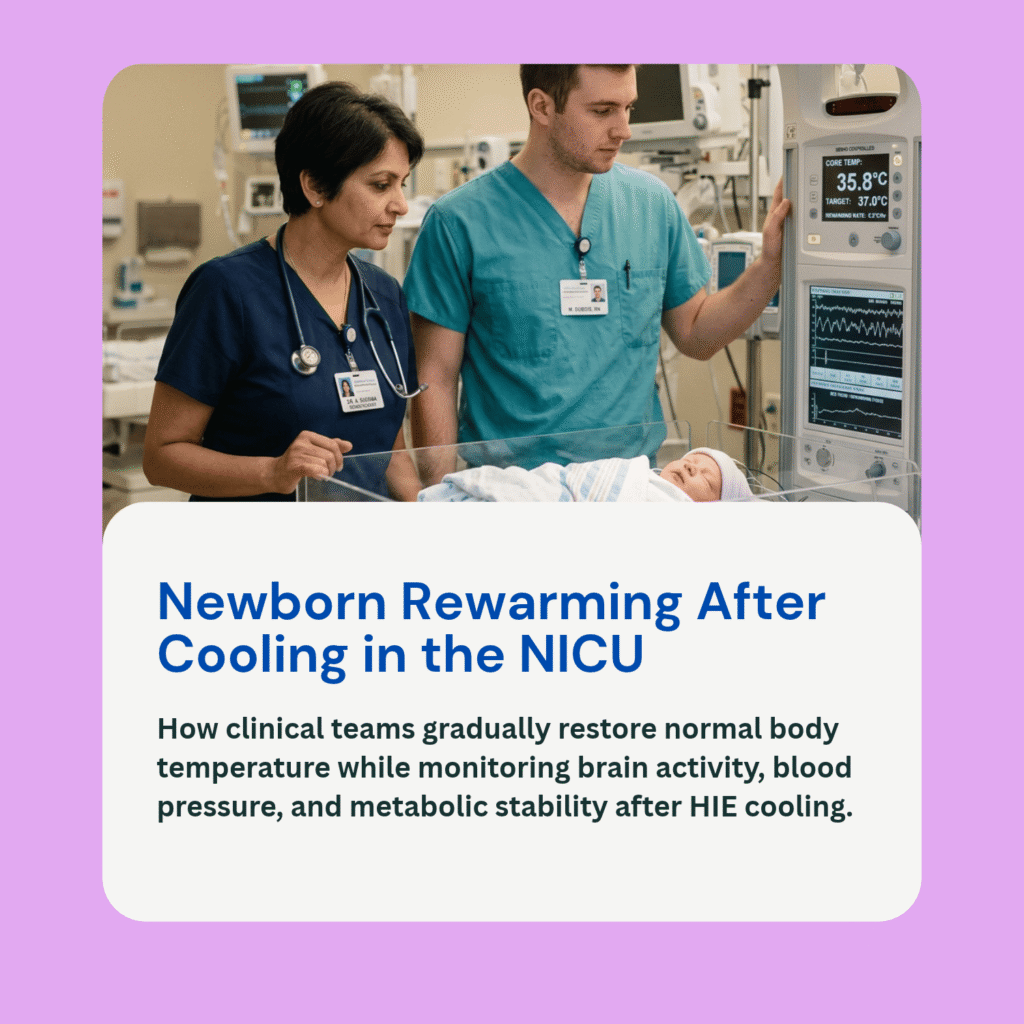
Vascular Access and Continuous Monitoring: A specialized neonatology team places central umbilical catheters or dedicated arterial and venous lines so blood can be exchanged smoothly without repeated needle sticks. Throughout the procedure, nurses continuously monitor heart rate, blood pressure, oxygen saturation, core temperature, and blood glucose.
Step-by-Step Blood Exchange: Over approximately two to three hours, clinicians perform small, slow push-pull cycles of blood removal and donor blood replacement. Keeping each cycle small and steady protects the infant’s delicate cardiovascular stability and prevents sudden shifts in blood pressure.
Post-Procedure Surveillance: Because bilirubin stored in body tissues shifts back into the bloodstream after the procedure (known as bilirubin rebound), intensive phototherapy continues immediately afterward, and doctors recheck serum bilirubin levels frequently over the next 24 hours.
Post-Treatment Follow-Up and Clinical Uncertainty
Completing a newborn exchange transfusion successfully removes dangerous circulating bilirubin, yet care teams remain vigilant during recovery. Neonatologists monitor electrolyte balance, platelet counts, and hemoglobin levels in the days following the procedure. Furthermore, because the auditory brainstem pathway is particularly sensitive to elevated bilirubin, infants who required escalation of care or exchange transfusion undergo formal diagnostic brainstem auditory evoked response (BAER) hearing evaluations before or shortly after discharge (refer internal link: Why Hearing Follow-Up Is Important After HIE).
Families are also connected with developmental tracking through a high risk infant follow up clinic to ensure motor milestones and auditory processing develop smoothly. Importantly, needing an exchange transfusion reflects severe underlying bilirubin production or neurotoxicity risk rather than predicting permanent injury. Many infants who receive timely escalation of care recover completely without long-term neurological deficits. Likewise, requiring an exchange transfusion does not by itself establish medical negligence; determining whether clinical screening and follow-up protocols were appropriately followed requires a comprehensive review of the complete obstetric and newborn medical record.
Frequently Asked Questions (FAQ)
Can parents manage severe newborn jaundice at home with sunlight or extra feedings?
No. While frequent feeding helps clear mild physiological jaundice, severe hyperbilirubinemia approaching escalation thresholds is a medical emergency that cannot be treated at home or with indirect sunlight. Prompt hospital laboratory testing and medical therapy are essential to protect the brain.
Is a newborn exchange transfusion safe?
Exchange transfusion is a complex, specialized NICU procedure that carries known medical risks, such as temporary fluctuations in blood pressure, electrolyte shifts, or catheter-related complications. Neonatologists recommend it only when the immediate danger of untreated bilirubin brain injury outweighs the procedural risks.
Will my baby still need phototherapy after an exchange transfusion?
Yes. After an exchange transfusion lowers blood bilirubin levels, bilirubin trapped in skin and tissues gradually moves back into the bloodstream. Continuing intensive phototherapy after the exchange helps clear this rebounding bilirubin and reduces the chance of needing a second exchange.