
Can Birth Injuries Cause Developmental Delays?
Watching a child grow, change, and learn during their first few years of life is a deeply rewarding experience for parents. During this rapid growth phase, pediatricians track a child’s progress using standardized milestones—behavioral, physical, and cognitive benchmarks that most children hit by a certain age. When a child begins to fall behind their peers, it naturally causes deep concern. For families who experienced a complicated labor or a traumatic delivery, a primary question frequently emerges: can birth injuries developmental delays be directly linked?
The short answer is yes. Structural trauma or prolonged oxygen deprivation during childbirth can damage delicate neurological pathways, directly affecting how a child processes information, moves their body, and communicates. Understanding the intersection of birth injuries developmental delays is crucial for parents who want to advocate effectively for their child’s health. This educational guide breaks down how birth trauma affects long-term development, the specific types of milestones to monitor, and how early clinical interventions can maximize your child’s functional progress.
The Neurological Link Between Birth Trauma and Delays
An infant’s brain is highly sensitive during labor and delivery. If a complication restricts blood flow or oxygen supply, or if mechanical forces physically compress the skull, delicate brain tissue can experience structural cell death. When looking at how birth injuries developmental delays unfold, the location and severity of this tissue damage dictate which specific milestones will be affected as the child grows.
For instance, damage to the motor cortex or basal ganglia frequently results in physical delays, while trauma to the frontal or temporal lobes may manifest years later as cognitive, behavioral, or language difficulties. Because a baby’s brain is still developing, the full impact of an intrapartum injury is rarely obvious in the newborn nursery; instead, the consequences reveal themselves gradually as the brain faces increasingly complex operational demands.
Types of Developmental Delays to Monitor
When tracking potential birth injuries developmental delays, medical professionals divide milestones into four core functional domains. A brain injury can impact a single domain or cause global delays across all four categories.
1. Gross and Fine Motor Delays
Motor delays are often the earliest visible indicators of an underlying birth injury. Gross motor skills involve large muscle groups used for rolling over, sitting upright, crawling, and walking. Fine motor skills involve precise movements, like grasping a rattle, transferring objects between hands, or pincering a piece of food. If an infant exhibits rigid, stiff muscles (hypertonia) or completely floppy, weak muscle tone (hypotonia), it may point to a motor tract issue stemming from birth trauma.
2. Language and Speech Delays
Speech delays involve both receptive language (understanding what is said) and expressive language (producing sounds and words). While it is normal for speech timelines to vary, a child who does not coo by 4 months, babble by 9 months, or say single words by 15 months should be evaluated. When considering birth injuries developmental delays, speech issues can stem from neurological processing challenges or physical nerve damage that impairs the muscles of the mouth, tongue, and vocal cords.
3. Cognitive and Intellectual Delays
Cognitive milestones track a child’s ability to think, learn, problem-solve, and explore their environment. In infants, this includes tracking moving objects with their eyes, searching for hidden toys (object permanence), and imitating simple gestures like waving goodbye. A birth injury that deprives the cerebrum of oxygen can alter cognitive processing speeds, making it harder for a child to hit these intellectual benchmarks on time.
4. Social and Emotional Delays
Social milestones involve how a child interacts with caregivers and peers. Early signs to watch for include a lack of a social smile by 3 months, an inability to make steady eye contact, a lack of responsiveness to a caregiver’s voice, or extreme, inconsolable distress that persists past the typical colic phase.
Differentiating Temporary Lags from Injury-Related Delays
It is vital for parents to remember that children develop at their own unique pace. A temporary lag in one specific milestone—such as walking a few weeks later than average—is common and often completely benign.
However, when evaluating birth injuries developmental delays, clinicians look for specific patterns that set them apart from normal developmental variations:
- Global Stagnation: The child is missing multiple, consecutive milestones across multiple domains (e.g., struggling to sit up and failing to babble or make eye contact).
- Asymmetry: The delay is accompanied by physical asymmetry, such as a child who only uses their left hand while keeping their right hand clenched in a fist, or a child who noticeably drags one leg while crawling.
- Regression: A critical warning sign where a child completely loses a skill they had previously mastered, such as an infant who was rolling over consistently but suddenly stops doing so entirely.
Clinical Diagnostic Steps and Therapeutic Interventions
If you suspect a connection between your child’s birth history and their current milestone timeline, seeking a formal medical evaluation is essential. Diagnosing birth injuries developmental delays involves a multidisciplinary approach:
- Developmental Screening: Specialized pediatricians use validated assessment tools (like the Ages & Stages Questionnaires) to objectively measure your child’s functional abilities against national averages.
- Neurological Mapping: A pediatric neurologist may order a brain Magnetic Resonance Imaging (MRI) or an Electroencephalogram (EEG) to check for structural brain lesions, scarring, or underlying seizure activity that could be stalling development.
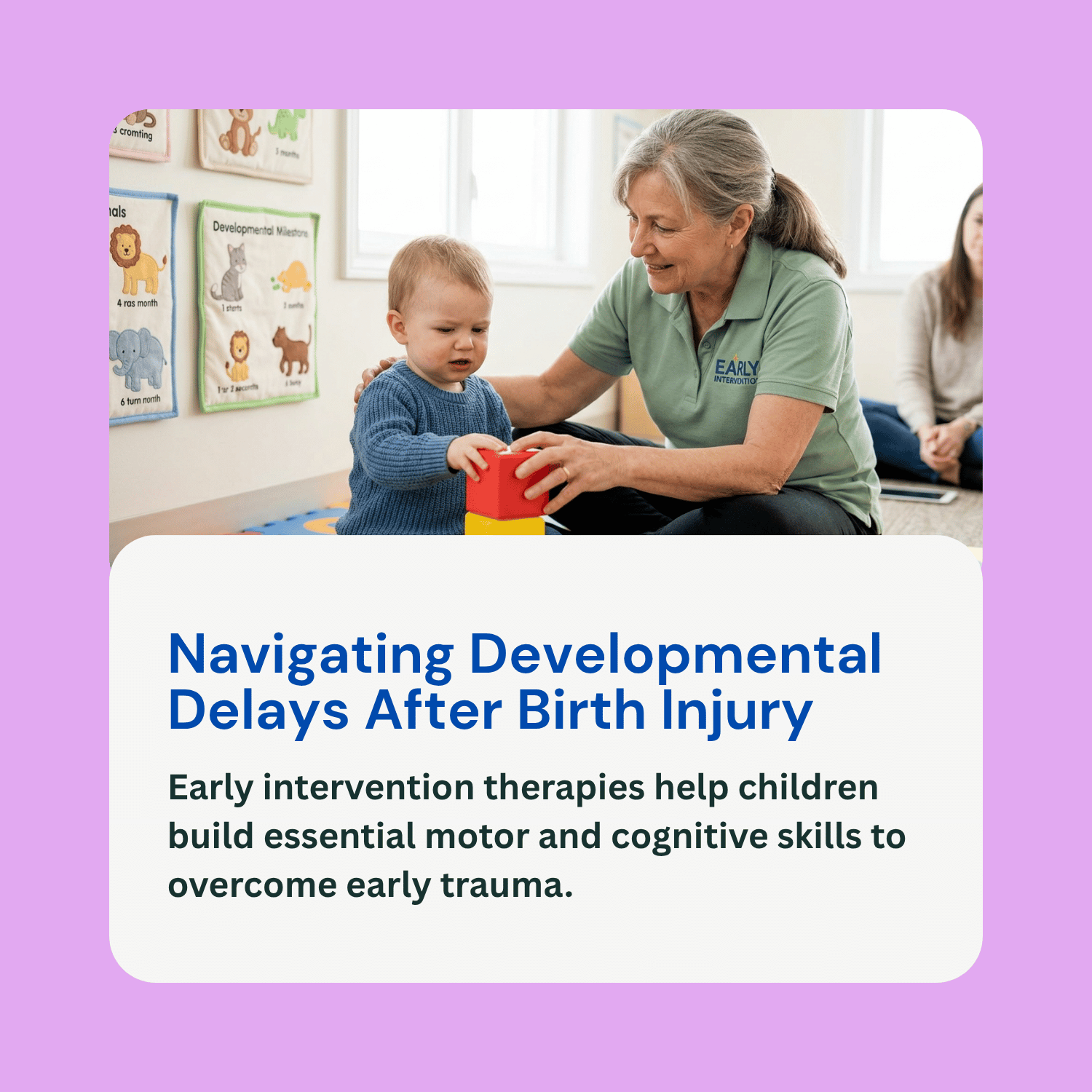
- Early Intervention Therapies: If a link between birth injuries developmental delays is confirmed, families can enroll in federally funded Early Intervention programs. These customized regimens utilize physical therapy to build muscle strength, occupational therapy to improve fine motor and self-feeding skills, and speech therapy to enhance communication pathways.
By intervening early, you take advantage of neuroplasticity—the infant brain’s remarkable ability to reorganize itself, form new neural connections, and bypass damaged areas to learn new skills.
Frequently Asked Questions (FAQ)
How do I know if my child’s developmental delay was caused by a birth injury?
A definitive link can only be established through a comprehensive medical review. A pediatric neurologist will look at your child’s delivery records for signs of fetal distress, emergency interventions, or low Apgar scores, and compare those findings with current neuroimaging (like an MRI) and observed milestone delays.
At what age do birth injuries developmental delays usually become noticeable?
While severe injuries affecting breathing or muscle tone are visible in the first weeks of life, milder birth injuries developmental delays often become apparent between 6 and 18 months, as the child misses complex physical milestones like sitting independently, crawling, or speaking their first words.
Can a child fully catch up if their delays are tied to birth trauma?c
Every child’s potential is unique and depends heavily on the location and severity of the initial brain tissue damage. While some children make incredible strides and completely bridge the gap through intensive early intervention therapies, others may face permanent challenges requiring long-term structural support.
What should I do if I suspect a link between birth injuries developmental delays?
Your first step should be discussing your specific observations with your pediatrician. Document the exact milestones your child is struggling with, request a formal developmental screening, and ask for a direct referral to a pediatric neurologist or an early intervention specialist for a definitive assessment.