
What Causes Brain Bleeds in Newborns?
The arrival of a newborn is supposed to be a time of celebration, but when unexpected medical complications arise, it can quickly become overwhelming for parents. One of the most alarming diagnoses a family can hear in the Neonatal Intensive Care Unit (NICU) is that their baby has experienced a neonatal brain bleed—clinically referred to as an intracranial hemorrhage (ICH).
Hearing that a newborn has bleeding inside or around the brain naturally sparks immediate panic and questions. Parents deserve clear, direct, and structurally organized information regarding why this happened and what it means for their child’s future. This educational guide breaks down the primary medical reasons behind brain bleeds in newborns, the symptoms to look for, how clinicians evaluate the severity, and what steps are taken to safeguard the baby’s developing brain.
The Core Causes of Brain Bleeds in Newborns
When examining why brain bleeds in newborns happen, physicians look at a combination of gestational development, labor delivery events, and systemic health conditions. The underlying triggers generally fall into three distinct medical categories:
1. Prematurity and Fragile Blood Vessels
Premature birth is the single most common risk factor for a specific type of bleed called an intraventricular hemorrhage (IVH). In infants born before 32 weeks, the blood vessels in a specialized region of the brain known as the germinal matrix are incredibly fragile and not fully developed. Because a premature infant’s system cannot easily regulate sudden shifts in blood pressure or oxygen levels, these micro-vessels can easily rupture, leaking blood into the brain’s fluid-filled ventricles.
2. Traumatic Delivery and Mechanical Force
Full-term infants can also experience intracranial bleeding, but it is more frequently tied to mechanical forces during a difficult labor. If a baby is disproportionately large for the mother’s pelvis (cephalopelvic disproportion), stuck in a prolonged labor, or delivered in an abnormal breech position, the physical stress on the fetal skull can cause deep tissue tears. Furthermore, the improper or overly aggressive use of operative delivery tools—such as vacuum extractors or forceps—can directly fracture skull elements or rupture blood vessels, leading to a preventable brain bleeds in newborns event.
3. Birth Asphyxia and Hypoxic-Ischemic Encephalopathy (HIE)
When a complication cuts off a baby’s oxygen supply during delivery (birth asphyxia), it initiates a dangerous chain reaction. Prolonged oxygen deprivation deprives cell walls of nutrients, causing a systemic breakdown of blood vessel integrity. When blood flow is eventually restored during resuscitation (reperfusion), the weakened, fragile walls of the blood vessels can give way under the pressure, triggering secondary brain bleeds in newborns.
Understanding Types and Classification (Grades 1–4)
Medical professionals categorize brain bleeds in newborns based on where the bleeding is located and how extensive it is. Bleeding within the fluid-filled spaces of the brain (ventricles) is scored using a standardized system that ranks severity from Grade 1 to Grade 4:
- Grade 1 Bleeding: The bleeding is strictly confined to a tiny area in the germinal matrix where the vessels first ruptured. The long-term neurological outlook is excellent, as these typically resolve on their own with little to no lasting damage.
- Grade 2 Bleeding: Blood spills inside the ventricles but does not cause them to expand or swell. The outlook remains favorable, and most infants recover without structural complications.
- Grade 3 Bleeding: The volume of blood is significant enough to cause the ventricles to enlarge and swell. The prognosis is variable, requiring close monitoring because the blood can block natural fluid pathways.
- Grade 4 Bleeding: The severe bleeding extends past the ventricles and spills directly into the surrounding functional brain tissue. This is a critical diagnosis that carries a high risk of permanent neurological injury or cerebral palsy.
Recognizing the Symptoms of an Active Bleed
Because newborns cannot voice their discomfort, medical teams and parents must remain highly vigilant for physical cues. While some small bleeds are clinically “silent” and only caught on a routine screening ultrasound, moderate-to-severe brain bleeds in newborns present clear neurological symptoms:
- Apnea and Bradycardia: Dangerous pauses in the baby’s independent breathing patterns paired with a sudden drop in heart rate.
- Bulging Fontanelle: The “soft spot” on top of the infant’s head may appear noticeably swollen, tight, or bulging due to increased fluid pressure inside the skull.
- Altered Muscle Tone: The baby may appear completely limp and unresponsive, or conversely, show sudden, rigid muscle stiffness.
- Neonatal Seizures: Abnormal brain waves manifesting as rhythmic twitching of limbs, repetitive lip-smacking, or uncoordinated eye-rolling.
- Lethargy and Weak Suck: An inability to stay awake for feeding, coupled with a severely diminished or absent natural sucking reflex.
The Long-Term Impact on Development
A diagnosis of a brain injury leaves parents wondering what the future holds for their child. For mild cases (Grades 1 and 2), the body is usually able to naturally reabsorb the blood over a few weeks, allowing the baby to meet normal developmental milestones on track.
However, severe instances of brain bleeds in newborns can damage brain tissue or cause post-hemorrhagic hydrocephalus—a dangerous accumulation of cerebrospinal fluid that builds up because blood clots block natural drainage pathways. This pressure can cause long-term complications including developmental delays, learning disabilities, and permanent motor control disorders like cerebral palsy (CP). Early identification through cranial ultrasounds allows medical teams to implement physical, occupational, and speech therapies early on, leveraging neuroplasticity to help the infant bypass injured zones.
Frequently Asked Questions (FAQ)
How are brain bleeds in newborns diagnosed?
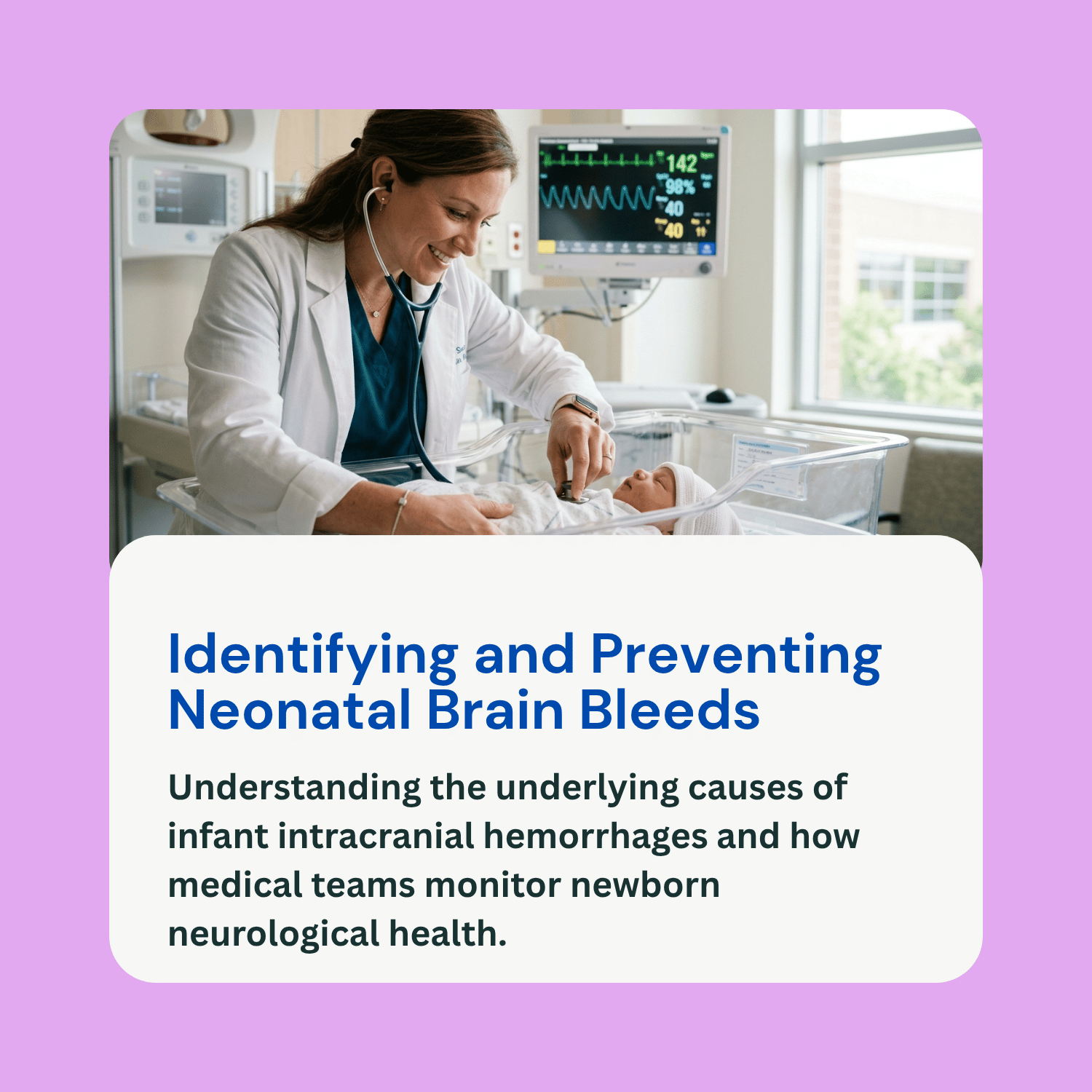
The gold-standard diagnostic tool is a non-invasive cranial ultrasound performed directly at the baby’s bedside in the NICU. Medical guidelines recommend that all infants born before 30 weeks receive a screening head ultrasound within their first two weeks of life to check for silent bleeding.
Can doctor errors cause brain bleeds in newborns?
Yes. While many brain bleeds are a natural complication of extreme prematurity, some are entirely preventable. Inappropriate force applied to an infant’s head, excessive pulling during a breech delivery, or a failure to order a timely emergency C-section when a baby is experiencing clear fetal distress can all constitute medical negligence that leads to a bleed.
What is the difference between a caput, a cephalohematoma, and an intracranial bleed?
A caput succedaneum is simple scalp swelling and bruising above the bone, which is benign. A cephalohematoma is a collection of blood under the scalp skin but outside the skull bone; it rarely damages the brain. Conversely, a true brain bleeds in newborns diagnosis means the bleeding is happening inside the skull cavity, either within the brain tissue or its fluid spaces, which can directly cause neurological injury.
Can a baby’s brain heal from a hemorrhage?
Yes, the infant brain has an extraordinary capacity for adaptation and healing. Mild hemorrhages typically resolve completely on their own. For more severe injuries, while damaged cells may not regenerate, specialized early intervention therapies help train surrounding, healthy parts of the brain to take over those lost functions.