
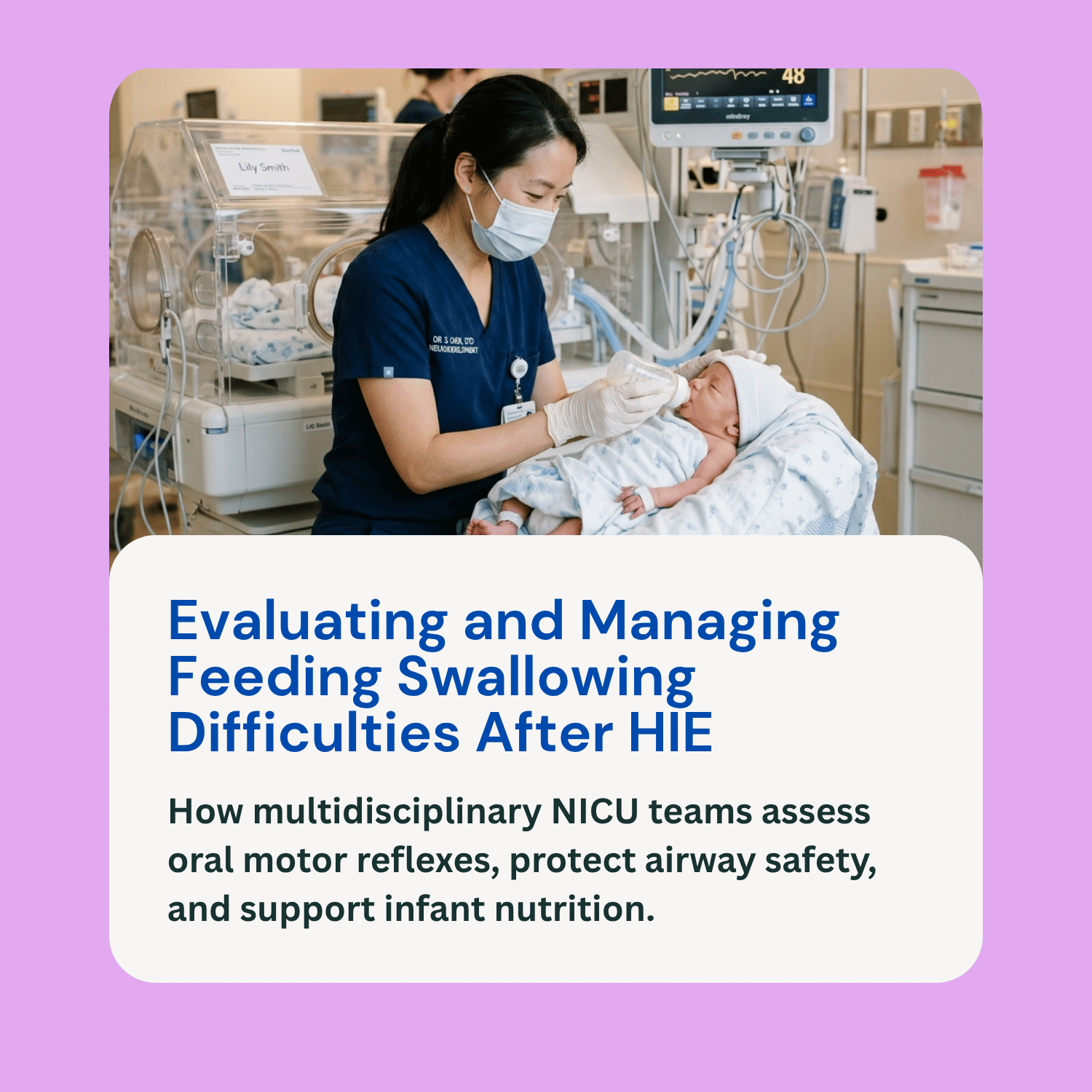

Why Can Feeding and Swallowing Be Difficult After HIE?
Safe and effective infant feeding requires a complex, highly coordinated sequence of oral, pharyngeal, and neurological actions. For a newborn to nurse or take a bottle, the brain must precisely integrate sucking, swallowing, and breathing while managing muscle tone in the lips, tongue, jaw, pharynx, and esophagus. When a baby experiences Hypoxic-Ischemic Encephalopathy (HIE) as a result of oxygen deprivation around the time of delivery, the neural pathways that control these automatic motor reflexes can be temporarily or persistently disrupted.
For families navigating post-asphyxial neonatal care, observing feeding swallowing difficulties after HIE is a common and understandable concern. Difficulty taking full oral feeds is often one of the main reasons infants require extended monitoring in the Neonatal Intensive Care Unit (NICU). Recognizing these challenges early allows clinical care teams to protect the baby’s airway, ensure adequate nutrition, and craft an individualized feeding plan. This educational resource explores the neurological mechanics of infant swallowing, how clinical feeding assessments are conducted, and how multidisciplinary teams support infant safety.
The Neurological Control of Infant Feeding
Feeding is one of the most complex neurological tasks a newborn performs. Unlike older children and adults, who swallow voluntarily, infant feeding relies heavily on brainstem-mediated reflex pathways:
Oral Motor Coordination: Sucking requires adequate tongue elevation, lip seal, and jaw stability to create negative pressure in the oral cavity. Neurological injury can lead to low muscle tone (hypotonia) or stiff muscle tone (hypertonia), making it difficult for the baby to latch or compress a nipple effectively.
The Pharyngeal Phase and Airway Protection: When milk moves to the back of the throat, the brainstem triggers the swallow reflex, momentarily closing the vocal cords and lowering the epiglottis to protect the airway. In infants with HIE, delayed reflex triggering or discoordination between swallowing and breathing can allow liquid to enter the airway (aspiration).
Esophageal Motility and Sensory Responses: Neurological injury can also alter gastrointestinal motility and visceral sensation, leading to delayed stomach emptying or gastroesophageal reflux, which further complicates oral feeds.
Recognizing Feeding and Swallowing Challenges in the NICU
Clinical teams closely observe infants recovering from neonatal encephalopathy for physical and behavioral indicators of oral motor dysfunction:
Weak or Uncoordinated Latch: The infant may struggle to initiate a strong suck, lose liquid from the corners of the mouth, or tire rapidly after only a few minutes of trying to nurse or take a bottle.
Signs of Airway Compromise: Coughing, choking, sputtering, clear throat-clearing sounds, or wide-eyed distress during feeding suggest that milk may be leaking into the larynx.
Silent Aspiration: In some infants with reduced pharyngeal sensation following oxygen deprivation, liquid enters the trachea without triggering a protective cough. Nurses monitor for subtle secondary signs, such as oxygen saturation dips, wet or gurgly vocal sounds after swallowing, or altered breathing rates.
Gating and Exhaustion: Babies recovering from neurological stress may fluctuate between states of deep lethargy and extreme irritability, making it challenging to sustain the calm, alert state required for safe oral feeding.
Evaluation and Multidisciplinary Care Teams
Determining the safest approach to infant nutrition involves comprehensive clinical evaluations and input from a specialized pediatric feeding team:
Bedside Clinical Feeding Assessment: A speech-language pathologist (SLP), occupational therapist (OT), or neonatal nurse specialist evaluates the infant’s oral reflexes, jaw stability, muscle tone, and suck-swallow-breathe rhythm during a test feed.
Instrumental Swallowing Studies: If silent aspiration or structural throat weakness is suspected, doctors may recommend objective imaging:
- Modified Barium Swallow Study (MBSS) / Videofluoroscopic Swallow Study (VFSS): A real-time X-ray video that records the passage of radiopaque milk from the mouth through the pharynx, identifying exactly where swallowing breakdown occurs.
- Fiberoptic Endoscopic Evaluation of Swallowing (FEES): Uses a tiny, flexible camera inserted gently through the nose to view the vocal cords and pharynx directly during feeding.
Supplemental Feeding Support: While oral motor skills recover, infants often receive temporary enteral nutrition through a nasogastric (NG) tube or orogastric (OG) tube. Tube feeding ensures the infant meets critical calorie requirements for brain healing without forcing unsafe oral feeds that risk respiratory complications.
Distinguishing Association from Diagnosis
It is important for parents and caregivers to understand that feeding challenges after birth reflect an association with neurological stress rather than a permanent, fixed diagnosis.
The newborn brain possesses significant neuroplasticity, and many infants show steady improvements in oral coordination as acute tissue swelling resolves and therapeutic interventions progress. A baby who requires a temporary feeding tube in the NICU is receiving supportive care to allow the brain and motor pathways time to recover. Clinical findings during the initial hospital stay serve as a baseline to guide post-discharge developmental follow-up, early intervention therapy, and individualized outpatient care.
Frequently Asked Questions (FAQ)
Why does my baby need a feeding tube if they can suck on a pacifier?
Sucking on a pacifier (non-nutritive sucking) requires oral muscle strength, but it does not require the baby to coordinate swallowing liquid while protecting their airway from liquid flow. Managing a liquid bolus safely while breathing requires higher-level brainstem coordination.
How long do feeding difficulties typically last after HIE?
The duration of feeding difficulties varies significantly based on the degree of neurological injury, baseline muscle tone, and overall recovery speed. Some infants transition to full oral feeds within a few weeks, while others benefit from ongoing outpatient feeding therapy and temporary supplemental tube feeding.
What is the main danger of feeding a baby who has swallowing incoordination?
The primary clinical concern is aspiration, which occurs when milk enters the lungs instead of the stomach. Persistent aspiration can cause chemical irritation, airway inflammation, and aspiration pneumonia.