
Can Delayed Delivery Cause Oxygen Deprivation?
Labor is a natural process that requires careful medical management to ensure the safety of both mother and baby. While every delivery moves at its own pace, a labor that stalls or becomes excessively prolonged can quickly escalate into a serious medical emergency. When labor extends far beyond expected clinical timelines without appropriate intervention, the infant faces a heightened risk of delayed delivery oxygen deprivation.
During every labor contraction, blood flow to the placenta is briefly compressed, momentarily reducing oxygen transfer to the baby. Between contractions, healthy blood flow resumes, allowing the baby to rest and reoxygenate. However, when labor becomes delayed, obstructed, or unnaturally prolonged, these constant physical pressures can exhaust the baby’s physiological reserves, leading to severe fetal distress and permanent birth injuries. This educational guide breaks down how delayed delivery causes oxygen loss, how medical teams monitor for distress, emergency interventions, and long-term outcomes.
How Delayed Delivery Triggers Oxygen Deprivation
The human fetus is designed to handle the temporary physical stress of normal labor. However, when delivery is unnecessarily delayed, several physiological factors combine to restrict the baby’s oxygen supply:
First, extended labor subjects the placenta to relentless pressure over many hours. If contractions occur too close together or last too long—often due to hyper-stimulation from labor-inducing drugs like Pitocin—the placenta does not have enough time to refill with fresh, oxygenated blood between surges. Over time, this cumulative oxygen debt leads to tissue hypoxia and blood acidity.
Second, prolonged labor increases the likelihood of mechanical complications. As the baby spends extra time wedged in the birth canal, the risk of umbilical cord compression, cord entanglement, or head trauma increases significantly. Low amniotic fluid levels or a rupture of membranes occurring hours before delivery further eliminate the protective cushion around the cord, leaving it vulnerable to flattening against the uterine wall.
Monitoring Fetal Distress During Prolonged Labor
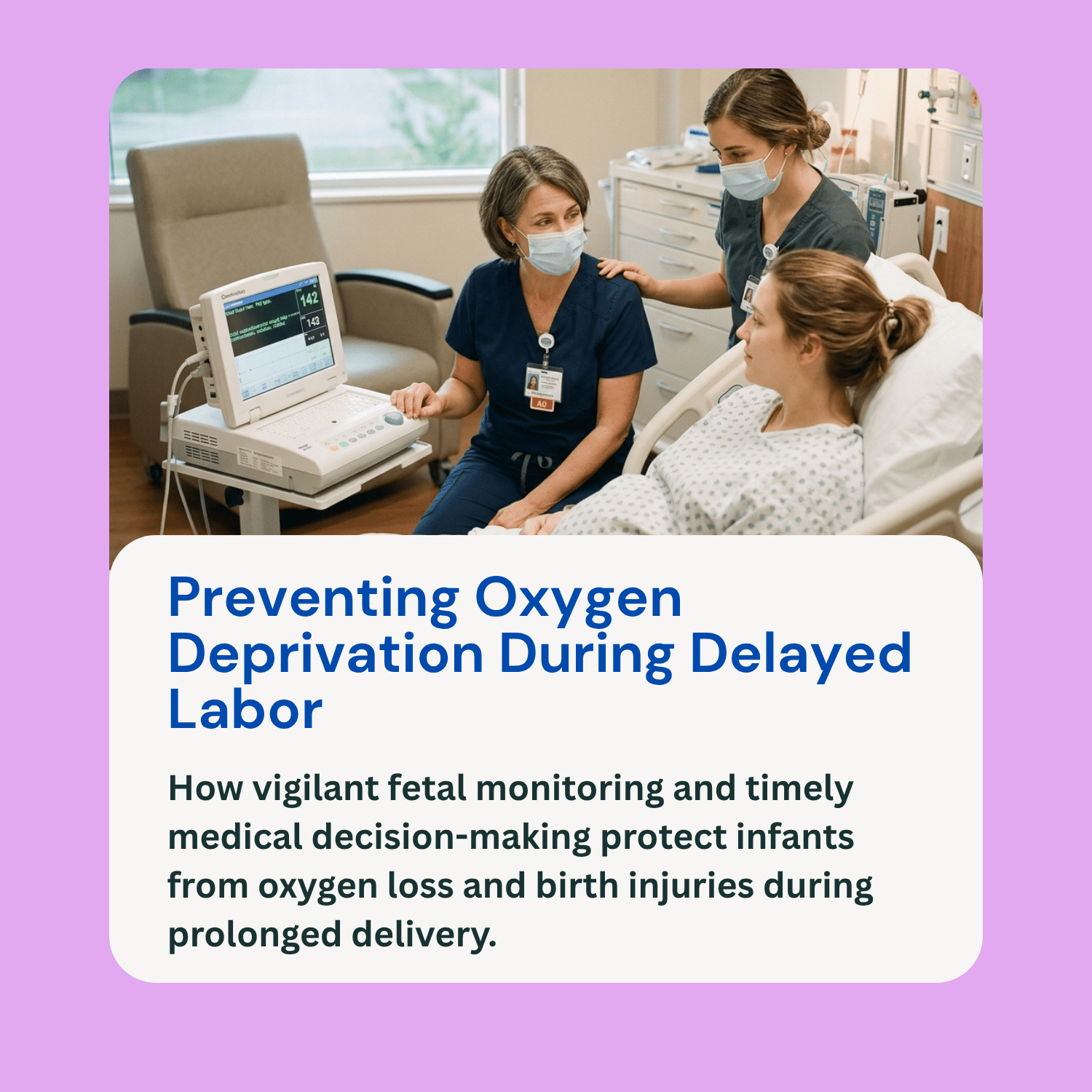
To prevent delayed delivery oxygen deprivation, labor and delivery teams rely heavily on continuous electronic fetal monitoring (EFM). Fetal monitors track the baby’s heart rate in relation to the mother’s contractions, providing a real-time window into how well the fetus is tolerating labor.
When a baby begins running out of oxygen during a delayed delivery, the monitoring strip will display distinct non-reassuring heart rate patterns. Key indicators of fetal distress include late decelerations (heart rate drops that occur after a contraction starts and take time to recover), severe variable decelerations (sharp drops indicating cord pinching), and a loss of overall heart rate variability (a flatline appearance replacing normal heart rate fluctuations). Clinicians may also notice heavy meconium staining in the amniotic fluid, which is a classic physical sign that a baby has passed a bowel movement due to acute physical stress in the womb.
Preventable Errors and Delayed Emergency C-Sections
Not all long labors lead to birth injuries, provided the medical team closely monitors the infant and intervenes when warning signs appear. However, when delivery room staff fail to act on fetal distress, delayed delivery becomes a primary driver of preventable birth injuries.
Common medical errors contributing to delayed delivery include failing to properly read electronic fetal monitoring strips, delaying communication with the attending obstetrician, or mismanaging labor-inducing medications like Pitocin. The most critical failure occurs when a medical team recognizes clear fetal distress but delays ordering or performing an emergency C-section. Standard medical guidelines dictate that once an emergency C-section is deemed necessary, the hospital team should move swiftly to deliver the infant before irreversible brain tissue damage occurs.
Potential Birth Injuries and Long-Term Outcomes
When a delayed delivery severely starves a baby of oxygen, the immediate result is birth asphyxia. Deprived of oxygenated blood, the baby’s metabolic system falters, triggering an inflammatory cascade that leads to tissue death in vulnerable body organs, most notably the brain.
The most common primary injury resulting from oxygen loss is Hypoxic-Ischemic Encephalopathy (HIE), an acute brain injury caused by restricted blood flow around birth. If HIE damages the motor centers of the brain, the child may develop cerebral palsy (CP), a lifelong condition affecting muscle tone, posture, and motor skills. Prolonged oxygen deprivation can also cause chronic childhood epilepsy, microcephaly, developmental delays, learning disabilities, or severe cognitive impairments.
Frequently Asked Questions (FAQ)
How long can labor be delayed before it becomes dangerous for the baby?
There is no single universal time limit, as every mother and baby tolerate labor differently. However, clinicians generally define prolonged labor as active labor lasting longer than 20 hours for a first-time mother or 14 hours for a mother who has given birth before. The key factor is not just the clock, but whether the baby is displaying signs of fetal distress on heart rate monitors.
What is the difference between failure to progress and delayed delivery?
“Failure to progress” is a clinical diagnosis meaning labor has slowed down or stopped moving forward (e.g., the cervix stops dilating or the baby stops descending). “Delayed delivery” refers to the resulting delay in getting the baby delivered safely—often due to a failure by medical staff to intervene promptly with medications or a C-section when failure to progress occurs.
Can brain cooling therapy help a baby who suffered oxygen deprivation from a delayed delivery?
Yes. If an infant is diagnosed with moderate-to-severe HIE following a delayed delivery, doctors can initiate therapeutic hypothermia (brain cooling) within the first 6 hours of life. By lowering the baby’s core body temperature to 33.5°C for 72 hours, cooling therapy can halt secondary brain damage and significantly reduce the risk of long-term disability.
Could delayed delivery oxygen deprivation be considered medical malpractice?
Yes. If labor nurses or doctors fail to monitor fetal heart rates, ignore clear signs of fetal distress, mismanage labor drugs, or unreasonably delay performing an emergency C-section, their failure to adhere to standard medical care may be considered preventable negligence.