
New York Notice of Claim for Birth Injury: The 90-Day Rule Every Parent Must Know
In the state of New York, the legal path to accountability following a traumatic delivery is determined almost entirely by the ownership of the hospital where the birth occurred. While many parents assume they have years to decide whether to file a lawsuit, those who deliver at public hospitals are subject to a much more aggressive timeline. A New York Notice of Claim birth injury filing is a mandatory prerequisite for anyone seeking to sue a municipal or city-run healthcare facility. Failure to navigate this procedural requirement correctly can result in a case being dismissed before a judge ever hears the merits of the medical evidence.
Most families are familiar with the concept of a “statute of limitations,” which in New York is generally two years and six months for medical malpractice. However, for public entities like the New York City Health + Hospitals (NYC H+H) system, the clock starts much earlier with the Notice of Claim. This document is a formal warning to the government that you intend to sue, and the window to file it is incredibly narrow. Understanding whether your hospital is public or private is the most important piece of information you can have in the days following a birth injury.
This comprehensive guide will break down the “90-day rule,” the specific hospitals that require a Notice of Claim, and the step-by-step process for protecting your child’s legal rights. We will explain why the government has these special protections and how you can avoid the procedural traps that have ended countless valid claims. In the complex world of New York birth injury law, being 24 hours late can be the difference between securing your child’s future and having no legal recourse at all.
Table of Contents
- Public vs. Private Hospitals: Identifying the Defendant
- The 90-Day Window: A Strict Deadline for Families
- What Must Be Included in the Notice of Claim?
- The 50-h Hearing: The City’s Right to Investigate
- The Statute of Limitations for Public vs. Private Claims
- Why the Government Has Special Protections
- The Consequences of Missing the Deadline
- Frequently Asked Questions
- Protecting Your Rights After a Traumatic Birth
Public vs. Private Hospitals: Identifying the Defendant
The first step in any birth injury investigation is identifying exactly who is responsible for the care provided during labor. In New York City, there is a clear distinction between prestigious private institutions and the public “safety net” hospitals run by the city. Private hospitals, such as New York-Presbyterian or Mount Sinai, do not usually require a Notice of Claim. However, if you delivered at a facility like Bellevue, Elmhurst, or Jacobi, you were in a public hospital governed by the New York City Health + Hospitals Corporation.
This distinction is not always obvious to a patient in the middle of a medical crisis. Many public hospitals are affiliated with major private universities, which can lead to confusion about who actually employs the staff. For example, while a doctor may be a faculty member at a private university, they may be providing care as an employee or agent of the city’s public health system. A skilled legal team must verify the employment status of every individual involved in the traumatic delivery to ensure the correct entities are served.
Outside of New York City, other public entities like Westchester Medical Center or Nassau University Medical Center also have their own specific notice requirements. Even some smaller county-run clinics and healthcare centers are protected by these municipal laws. If you are unsure about the status of your hospital, you must act as if the 90-day rule applies until a lawyer confirms otherwise. Taking a “wait and see” approach is the most dangerous strategy a parent can adopt in this situation.
The 90-Day Window: A Strict Deadline for Families
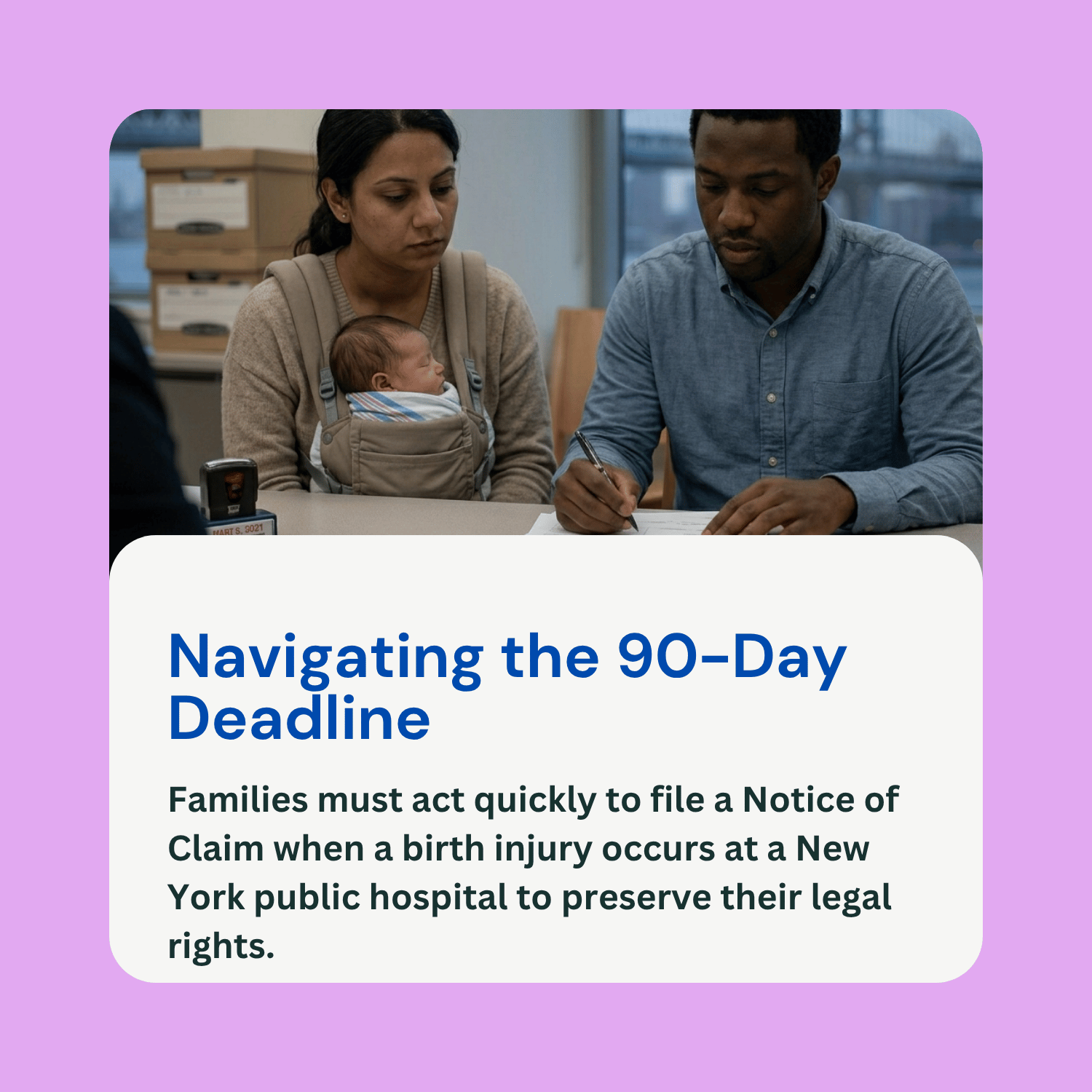
The New York Notice of Claim birth injury deadline is set at exactly 90 days from the date the malpractice occurred. This means that from the moment your child is injured during delivery, you have roughly three months to investigate the incident, hire an attorney, and file the formal notice. This timeline is significantly shorter than the standard statute of limitations, and the courts rarely grant extensions for simple mistakes or ignorance of the law. The 90-day rule exists to give the city an early opportunity to investigate the claim and potentially settle before a lawsuit is filed.
For parents of a newborn with a birth injury, these 90 days often pass in a blur of NICU visits, specialist appointments, and emotional recovery. It is understandable that legal paperwork is the last thing on a parent’s mind during such a vulnerable time. However, the law does not take these emotional burdens into account when enforcing the filing deadline. This is why it is essential to contact a birth injury specialist as soon as you suspect that something went wrong during your labor.
There are very few exceptions to the 90-day rule, and they are difficult to win in court. A judge may allow a “late Notice of Claim” if the hospital had “actual knowledge” of the facts within the 90-day window, but simply having medical records on file is usually not enough to prove actual knowledge. You must demonstrate that the records clearly reflected the medical staff’s negligence and the resulting injury. Because this is a high legal bar to clear, the only safe way to proceed is to file the notice well within the original 90-day period.
What Must Be Included in the Notice of Claim?
A Notice of Claim is not a casual letter; it is a formal legal document that must contain specific information as required by General Municipal Law Section 50-e. The document must state the name and address of the claimant and their attorney. It must also provide a detailed description of the “time when, the place where, and the manner in which the claim arose.” This means you must specify the exact date and hour of the delivery and the specific room or unit where the malpractice took place.
Furthermore, the notice must describe the nature of the injuries and the damages being sought. In a birth injury case, this would include a description of the baby’s condition, such as HIE or Erb’s palsy, as well as any injuries the mother sustained. You do not need to provide every minute detail of the medical evidence at this stage, but the notice must be specific enough to allow the city to conduct its own investigation. If the notice is too vague, the city may move to dismiss the claim later for being “defectively served.”
The document must also be verified, which means it must be signed by the claimant in the presence of a notary public. Once it is prepared, it must be served on the correct municipal department, usually the New York City Comptroller’s Office, in a specific manner. This can be done through personal delivery, registered mail, or certified mail. Keeping the “proof of service,” such as a stamped receipt or a mailing tracking number, is the only way to prove that you met your legal obligations.
The 50-h Hearing: The City’s Right to Investigate
After you file a New York Notice of Claim birth injury document, the city has the right to demand a “50-h hearing.” This is a pre-lawsuit examination under oath where an attorney for the city or the hospital system asks the parents questions about the incident and the injuries. The hearing is similar to a deposition but occurs much earlier in the process. It is a mandatory step, and if you fail to appear for a scheduled 50-h hearing, you may be barred from ever filing your lawsuit.
During the hearing, the city’s lawyer will ask about the details of the pregnancy, the events of the labor, and the current health status of the child. They are looking for any information that could potentially weaken your case or suggest that the injury was not caused by medical negligence. It is vital to be prepared for this hearing by your own attorney, as your testimony is recorded and can be used against you later in court. Having an experienced lawyer by your side ensures that you do not inadvertently say something that damages your child’s legal standing.
In addition to the verbal testimony, the city may also demand a physical examination of the injured child. This is conducted by a doctor of the city’s choosing to verify the extent of the disability. While this can feel intrusive, it is a standard part of the municipal litigation process in New York. Complying with these investigative steps is the price of admission for seeking justice against a public hospital system.
The Statute of Limitations for Public vs. Private Claims
It is a common misconception that the Notice of Claim is the only deadline parents need to worry about. Even after the notice is filed and the 50-h hearing is completed, you still have a deadline to file the actual lawsuit. For most municipal entities in New York, the lawsuit must be commenced within one year and 90 days of the event. This is much shorter than the standard 30-month statute of limitations for private medical malpractice cases.
However, there is an important exception for injuries to children. Under New York law, the statute of limitations for a child’s claim can be “tolled,” or paused, because of their “infancy.” This means that while the parents’ own claims for their injuries might expire quickly, the child’s claim can often be brought several years later. In birth injury cases, this tolling is usually limited to a maximum of 10 years. This means the lawsuit for the child’s injuries must be filed before their 10th birthday.
The trap for many parents is that the “tolling for infancy” does not always apply to the Notice of Claim requirement in the same way. While some courts have been more lenient with late notices for children, you should never rely on this leniency. The safest and most effective way to handle a public hospital case is to treat the 90-day Notice of Claim deadline as absolute. Protecting both the parent’s claims and the child’s claims requires immediate action in the first three months of the child’s life.
Why the Government Has Special Protections
Many parents feel that the 90-day rule is unfair, and they are not entirely wrong. These laws were created to protect the “public purse” and to ensure that government agencies are not hit with surprise lawsuits years after an event occurred. By requiring an early notice, the law allows the city to investigate while the staff members are still employed and the medical records are fresh. While this serves the government’s interests, it places a heavy burden on families who are already in the middle of a medical crisis.
These protections are a remnant of “sovereign immunity,” which is the ancient legal principle that the government cannot be sued without its consent. In New York, the government has consented to be sued for negligence, but only if you follow their specific rules. If you do not follow the rules, the government “withdraws” its consent, and you lose your right to seek compensation. This is why municipal litigation is one of the most technically demanding areas of personal injury law.
Because of these complexities, many general practice lawyers refuse to take cases involving NYC Health + Hospitals. They understand that one small procedural error can lead to a malpractice claim against them. For families, this means you must seek out a firm that specializes specifically in birth injuries and that has a proven track record of successfully litigating against the City of New York. You need a team that knows the Comptroller’s office and the specific requirements of the local courts.
The Consequences of Missing the Deadline
The consequence of missing the 90-day New York Notice of Claim birth injury deadline is usually the total loss of your legal rights. If you try to file a lawsuit without a timely notice, the defense attorney will file a “motion to dismiss” almost immediately. In the vast majority of cases, the judge will have no choice but to grant that motion. It does not matter how severe the baby’s injury is or how obvious the doctor’s mistake was; the procedural failure overrides the medical facts.
This is a devastating outcome for families who are facing millions of dollars in future medical costs. Without a legal settlement, the burden of paying for specialized therapy, nursing care, and adaptive equipment falls entirely on the parents and the taxpayers. This can lead to financial ruin for families who were already struggling to manage the demands of a child with special needs. The law is unforgiving in this regard, making the first 90 days after a traumatic birth the most critical period for a child’s future.
If you have already missed the 90-day window, you should still consult with an attorney to see if a “motion for leave to file a late Notice of Claim” is possible. This is a complex legal maneuver where you ask a judge for special permission to file after the deadline. To win, you must usually prove that the delay was reasonable and that the hospital was not “prejudiced” by the lateness. While these motions are difficult to win, they are the only remaining option for families who were not informed of their rights in time.
Frequently Asked Questions
1. Which NYC hospitals are considered “public”?
Public hospitals in the NYC H+H system include Bellevue, Coney Island (South Brooklyn Health), Elmhurst, Harlem, Jacobi, Kings County, Lincoln, Metropolitan, Queens, and Woodhull. If your child was born at any of these facilities, the 90-day Notice of Claim rule applies. Private hospitals like NYU Langone or Lenox Hill do not have this specific 90-day requirement.
2. Can I file the Notice of Claim myself?
While it is technically possible for a layperson to file a Notice of Claim, it is extremely risky. The document must meet specific legal standards and be served on the correct office in a specific way. Any error in the description of the event or the service of the papers can result in the case being dismissed. Hiring a lawyer ensures the process is done correctly and protects your proof of service.
3. Does the 90-day rule apply to the baby’s injuries too?
Yes, the 90-day Notice of Claim rule applies to both the mother’s injuries and the baby’s injuries. While courts sometimes allow a “late notice” for a baby because of their “infancy,” this is not guaranteed and requires a separate legal motion. You should always aim to file the notice for both the mother and the baby within the first 90 days to be safe.
4. What happens if I move out of New York after the birth?
Moving out of the state does not change the filing requirements. The laws of the state where the injury occurred govern the legal process. You must still file the Notice of Claim with the New York City Comptroller or the appropriate municipal office within 90 days, regardless of where you currently live.
5. Is a Notice of Claim the same thing as a lawsuit?
No, a Notice of Claim is a “condition precedent” to a lawsuit. It is a formal notification that you intend to sue the city. You cannot file the actual lawsuit until at least 30 days have passed since the service of the notice. This 30-day “waiting period” gives the city time to settle the claim before it reaches the court system.
6. Can I sue the individual doctor instead of the hospital to avoid the 90-day rule?
In many cases, the answer is no. If the doctor was an employee of the municipal hospital and was acting within the scope of their employment, they are protected by the same notice requirements as the hospital itself. Suing the doctor individually usually does not allow you to bypass the General Municipal Law requirements.
7. What does it cost to file a Notice of Claim?
Most birth injury lawyers work on a contingency fee basis, which means there are no upfront costs for the family. The lawyer will cover the expenses of preparing and serving the Notice of Claim and will only be paid if they successfully recover money for your child. This allows families to access high-quality legal help regardless of their current financial situation.
Protecting Your Rights After a Traumatic Birth
If you have experienced a traumatic delivery at a public hospital in New York, the most important thing you can do is act quickly. Every day that passes is one day closer to the 90-day deadline that could end your case before it begins. Do not wait for the hospital to admit they made a mistake, as they are often instructed by their legal departments not to do so. You must take the initiative to protect your family and your child’s future.
Your first step should be to confirm whether your hospital is part of a municipal system. Once you have that information, contact a specialized birth injury attorney who can evaluate your case and prepare the necessary Notice of Claim. They can handle the technical details of the filing while you focus on caring for your newborn and your own physical recovery. This partnership is the most effective way to navigate the “procedural minefield” of New York municipal law.
Remember that the 90-day rule is a hurdle designed to limit the city’s liability, but it is a hurdle that can be cleared with the right help. By being proactive and seeking legal advice early, you are ensuring that your child’s needs will be met and that the responsible parties are held accountable for their actions. Your child’s journey toward justice starts with a single, timely document.